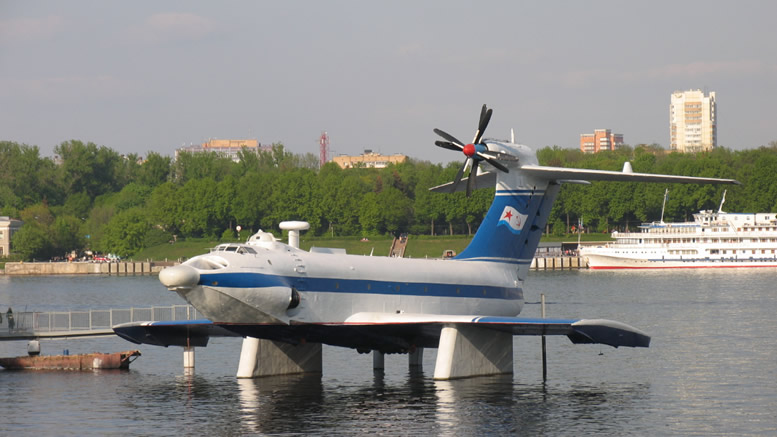
 The Russian Ekranoplan looks like an aircraft, but it only flies a few metres above water. Translated, the Russian name Ekranoplan means sea skimmer, and this is exactly what the Ekranoplan does. The Ekranoplan is what is known as a Ground Effect Vehicle, it operates on the principle of wing in ground effect, where the air gap between a wing and the ground is small enough for the air to be compressed.
Born out of the Soviet Union’s Central Hydrofoil Design Bureau, it was developed by their chief designer Rostislav Alekseev. Several Ekranoplans were developed from 1961 to 1990. Since the fall of the Soviet Union, many of the design team from the CHDB have formed a new company with plans to develop new craft for passenger and cargo usage. Also, 11 small 5 passenger craft were constructed between 1995 and 1997, they were used in trial commercial operation in the USA and the Bahamas.
The benefit of Ground Effect Vehicles is they can carry very heavy payloads economically at fast speeds. This is one of the reasons the former Soviet Union invested in their development as they were seen as
military benefit, one added bonus in flying low just above the water is they can keep below enemy radar. The largest Ekranoplan could transport over 100 tonnes of cargo and would use less fuel to cover the same distance of an aeroplane at the same speed.
The largest Ekranoplan called the KM was built in 1967, it was dubbed the Caspian Sea Monster after the sea it was on when first seen by the west. It was almost twice the length of a Boeing 777-200, but as with all Ground Effect Craft, it needs only half the wingspan. At over 100 m long, weighing 540 tons fully loaded, the KM could travel over 400 km/h mere meters above the surface of the water. Once moving at speed, the Ekranoplan was no longer in contact with the water, and could move over ice, snow, or level land with equal ease.
The important design principle is that the wing lift reduces the further above the surface of land or sea that the Ekranoplan “flies”. Thus, it’s dynamically stable in the vertical dimension.
These craft were originally developed by the Soviet Union as very high-speed (several hundred km/hour) military transports, and were mostly based on the shores of the Caspian Sea and Black Sea. The largest could transport over 100 tonnes of cargo.
The term ground effect vehicle is often misapplied to hovercrafts, which use fans to form an air cushion (hence the correct term air cushion vehicle) rather than relying on true ground effect. They are also confused with hydrofoils, which were also developed by the same Russian design Bureau. Similar in operation, Hydrofoils are more like a boat with wings that sit in the water, it makes the Hydrofoil look like a boat on ski’s.