 The Space Shuttle program was an ongoing endeavour, started in the late 1960s, that had created the world’s first partially reusable space launch system, and the first spacecraft capable of carrying large satellites both to and from low Earth orbit. Each shuttle was designed for a projected lifespan of 100 launches. The original purpose of the program was to ferry supplies to a space station. In reality, the Shuttle is the United States’ sole manned launch vehicle and has totally dominated NASA’s operations since the mid 1970s. When the construction of the International Space Station started the Shuttle had finally begun to be used for its original purpose. In January 2004, it was announced that the Shuttle fleet would be replaced by 2010.
The idea for the shuttle began around the 1960s as the Apollo development was winding down. NASA had wanted to develop reusable spacecraft to replace their costly “one-off” systems like Mercury, Gemini, and Apollo. Meanwhile the Air Force had a continuing interest in smaller systems with more rapid turn-around times, and were involved in their own space plane project called Dynasoar. NASA had plans for a program consisting of a large space station being launched on huge boosters, served by a reusable logistics “space shuttle”, both providing services for a permanently manned Lunar colony and eventual manned missions to Mars.
However reality was to interject and NASA found themselves with a rapidly plunging budget. Rather than stepping back and looking at their future as a whole given their new financial situation, they attempted to save as many of the individual projects as possible. The mission to Mars was quickly eliminated, so too was the Space Station plan rather reluctantly. They continued with the low-cost Shuttle plan as without it a large station would never be affordable in the future.
A number of designs were proposed, but many of them were complex and varied widely in their systems. An attempt to re-simplify was made in the form of the “DC-3”. The DC-3 was a small craft with a 20,000lbs (or less) payload and a four-man crew. it was simple in design and cheap to operate. looking back this design may have served NASA better than what they ended up with.
With NASA’s funding being cut more and more the only way they could go further was to join their project with the Air Forces need to launch Spy Satellites, something the Air Force was doing on Titan rockets. The Air Force agreed to pitch in for the shuttle as it made sense on paper to share the cost of the project, but the Air Force had different needs to NASA so they demanded a large increase in capability to allow for launching their spy satellites into polar orbits, which requires more energy to get to than the more common low Earth orbit.
The result was that the simple DC-3 was clearly out of the picture because it had neither the cargo capacity nor the cross-range the Air Force demanded. In fact all existing designs were far too small, as a 40,000 lbs delivery to polar orbit equates to a 65,000 lbs delivery to a “normal” 28 degree equatorial orbit. In fact any design using simple straight or fold-out wings was not going to meet the cross range requirements, so any future design would require a more complex, heavier delta wing.
Worse, any increase in the weight of the upper portion of a launch vehicle, which had just occurred, requires an even bigger increase in the capability of the lower stage used to launch it. Suddenly the two-stage system grew in size to something larger than the Saturn V, and the complexity and costs to develop it skyrocketed.
With the budgets being pressed by inflation at home and the Vietnam War abroad, Congress and the Administration generally couldn’t care less about anything as long-term as space exploration and were therefore looking to make further deep cuts to NASA’s budget. But with a single long term project on the books, there wasn’t much they could do in terms of cutting whole projects — the shuttle was all that was left, cut that and there would be no US manned space program by 1980.
Instead they looked to reduce the year-to-year costs of development to a stable figure. That is, they wished to see the development budgets spread out over several more years. This is somewhat difficult to do–you can’t build half a rocket. The result was another intense series of redesigns in which the re-usable booster was eventually abandoned as impossible to pay for. Instead a series of simpler rockets would launch the system, and then drop away for recovery. Another change was that the fuel for the shuttle itself was placed in an external tank instead of internal tanks from the previous designs. This allowed a larger payload bay in an otherwise much smaller craft, although it also meant throwing away the tankage after each launch.
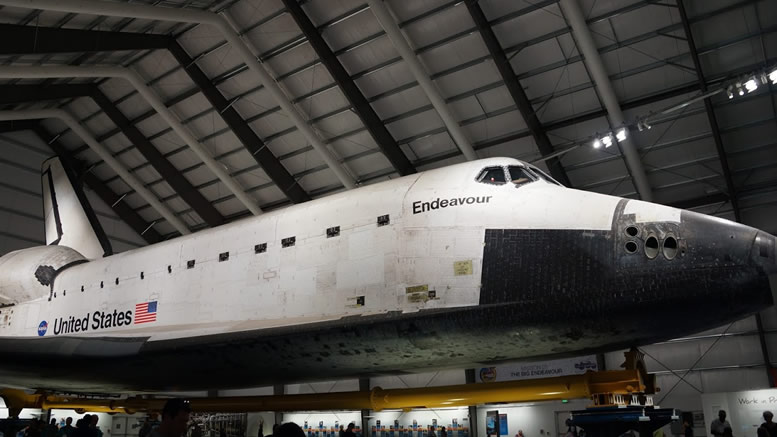
The shuttle program was launched on January 5, 1972 and the prototype shuttle “the enterprise” was complete by 1976 and only used for testing. The first fully functional shuttle orbited was the Columbia, which was delivered to Kennedy Space Centre on March 25, 1979 and was first launched on April 12, 1981 with a crew of two. Challenger was delivered to KSC in July 1982, Discovery was delivered in November 1983, and Atlantis was delivered in April 1985. Challenger was destroyed in an explosion during launch in January 1986 with the loss of all seven astronauts on board, and Endeavour was built as a replacement (using spare parts originally built for the other orbiters) and delivered in May 1991. Columbia was lost, with all seven crew, in a re-entry mishap on February 1, 2003.
Whilst the shuttle has been a reasonably successful launch vehicle, it had been unable to meet its goals of radically reducing flight launch costs, as each flight costs on the order of $500 million rather than initial projections of $10 to $20 million. continual design improvements and testing has 25000 people working on the shuttle program, the idea behind a reusable craft was to get the shuttle working on a two week turn around, in reality this can take months. The Reason for designing the Shuttle the way it is was to get the Air Force involved, by the time the project had got too far the Air Force gave up on the shuttle and returned to using titan rockets. Today NASA are looking to replace the Shuttle with an Orbital Space Plane project to become a ferry to and from the ISS, this OSP will be a simpler design perhaps not far different to what NASA wanted in the first place.