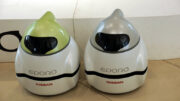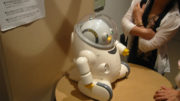
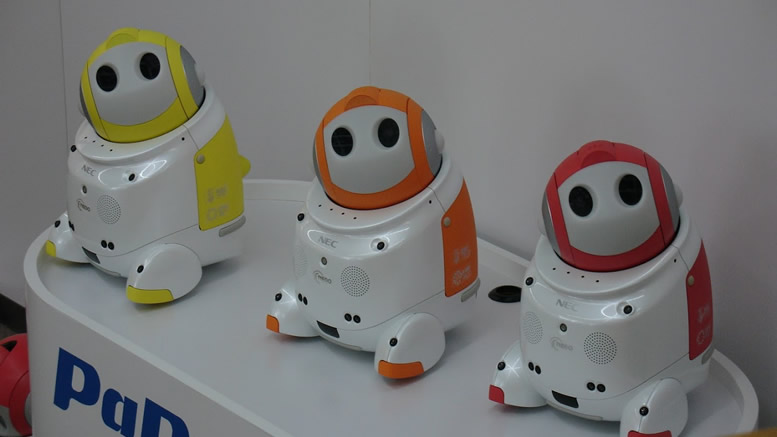
PaPeRo was named after an acronym of “Partner-type Personal Robot.” It is a prototype “Personal robot” that communicates with human beings as one of the family members at home.
NEC started to develop PaPeRo in 1997, then known a R100 its appearance has changed very little as NEC strive to develop the robot’s software Known as “Robo Studio” to enable better human to robot interaction.
The R100 was replaced by PaPeRo in 2001 and he has upgrades in 2003 and in 2005 to coincide with his display at Expo 2005 in Japan.
PaPeRo has been upgraded from his 2003 spec of a Celeron 500 with a 6 gig hard drive to a Pentium M 1.6 with a 40 gig HDD. His memory is now up from as little a 60 meg to 512meg, something that should really help PaPeRo process his voice recognition tasks.
Early versions of PaPeRo had limitations with his voice recognition that have now been overcome with the 2005 version. PaPeRo had to process the incoming audio and could not do this if he was talking or processing the last conversation. Lights were installed on his ears that would come on when he wasn’t thinking or talking to indicate he was ready to listen, as this is not the way humans expect to interact with each other NEC have developed the 2005 version to the stage where he can process your commands at any time just like a human would expect him to.
One of the Future expcted uses of a robot like PaPeRo is child care and so several features for this purpose have been developed. Using image recognition technology, PaPeRo can remember and identify people. It uses stereoscopic vision made possible by the two cameras in its eyes, to know the distance between it and others and move to an appropriate position. It recognizes people by searching for facial features in the original image captured by the cameras and compares them against faces and mouths already in its memory. Once it finds a match, it identifies the person and recalls his/her name, which is also stored in memory. Improvements have been made so as to distinguish children who tend to move continuously.
PaPeRo also has a built-in mobile phone. When a parent calls PaPeRo, PaPeRo locates their child and starts playing with him/her. The telephoning parent can then use the TV conferencing feature of the mobile phone to watch their child playing with PaPeRo via the cameras in PaPeRo’s eyes. The parent can also talk to their child using PaPeRo’s microphones and speakers.
NEC are also working with a well know Japanese comedian Zenjiro to develop PaPeRo into a robot with a sense of humor known as PaPe-jiro. NEC believe that to have a robot companion in the home, the mere ability to assist the family with various chores is not enough; it also needs to be able to converse with family members in a pleasant way, so that they develop a fondness for it, also by developing a robot with a sense of humor is just one more step forward to developing robots that can converse naturally with humans in daily life.
PaPeRo is a development robot and as such is not for sale at this time, hopefully with all the work NEC are putting into this cute robot it will be just a mater of time before robots like this are wizzing around our homes entertaining us.