 The process to keep food cold by using a evaporative cooling system goes back a long time. The Romans used terracotta pots in water fanned by slaves to cool their food, but it was not until the 19th century that other liquids that would evaporate quicker if under compression were discovered.
In 1834 an American inventor named Jacob Perkins obtained the first patent for a refrigerating machine, it used ether in a vapour compression cycle. His machine never had much interest as there was already a well established natural ice industry. Perkins later established a factory in England based on an earlier invention he had for printing bank notes.
The natural ice industry was big business in the U.S. and Europe ice was cut from the lakes in winter and stored during the summer, by 1890 the U.S. was exporting 25 million tons of ice, but in Australia it was not cold enough to harvest ice in this way so it was very costly keep food cool.
In 1837 a journalist named James Harrison moved to Geelong Australia from Glasco and set about designing his own machine. His first machine did not work so he took it to England and with the help of a Doctor Seabe he got it working. Harrison returned to Australia in 1856 with the working machine, he was commissioned by a brewery to build a machine to cool beer and this was the first practical use of a refrigeration machine.
The first absorption machine was developed by Edmond Carre in 1850, using water and sulphuric acid. His brother, Ferdinand Carre developed the first ammonia/water refrigeration machine in 1859. Many sources show that this machine of Ferdinand’s was the first Refrigerator with no mention of Harrison, Perkins or his brother Edmond Carre.
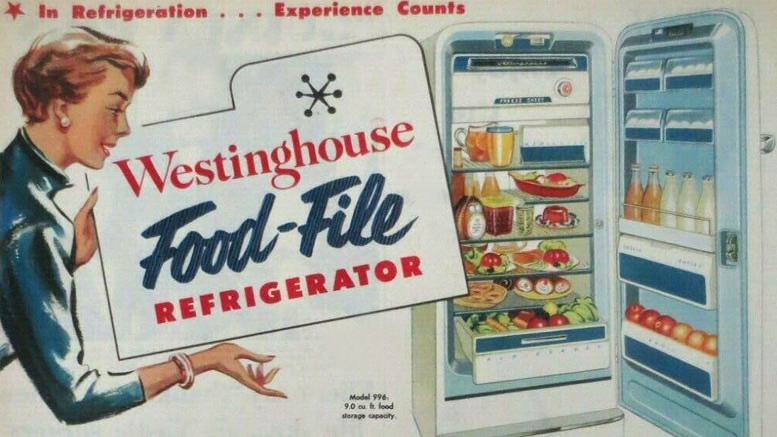
Within a few years ice factories popped up all over the world to compete with the natural ice industry but the first home unit did not arrive until 1927 when G.E. enclosed the parts in a small cabinet. By the 1950’s stylists were designing the refrigerators and in the late 60’s the large latching doors were dropped when magnets were placed in the seals, thus reducing costs.