
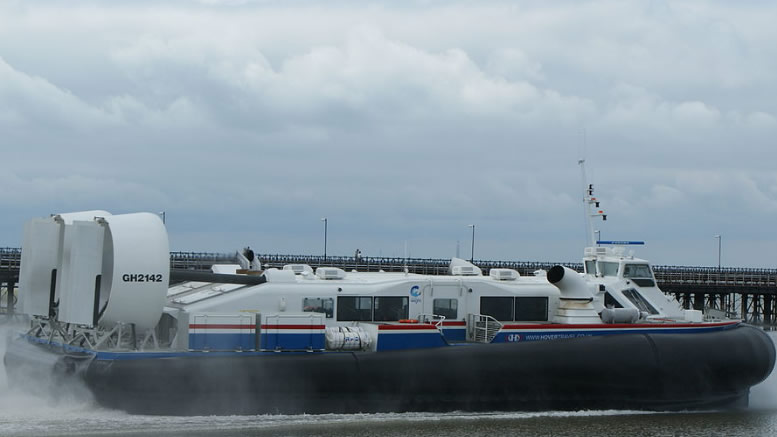
 A hovercraft is a vehicle that is supported on a cushion of air. It is able to traverse many different types of terrain on land and can also travel on water.
The hovercraft was invented in 1952 by the British inventor Sir Christopher Cockerell, who was knighted for his services to engineering in 1969. By simple experiments involving a vacuum cleaner motor and two cylindrical cans he proved the workable principle of a vehicle suspended on a cushion of air blown out under pressure, making the vehicle easily mobile over any surface. This would enable it to operate over soft mud, water, and marshes and swamps as well as on firm ground.
The British aircraft manufacturer Saunders Roe developed the first practical man-carrying hovercraft, the SR-N1, which carried out several test programmes in 1959 to 1961 (the first public demonstration in 1959), including a cross-channel run. It was found that the craft’s lift was improved by the addition of a ‘skirt’ of flexible fabric or rubber around the hovering surface, to contain the air.
The SR-N1 was powered by one [piston] engine, driven by expelled air, and could carry little more than its own weight and two men. The first true passenger-carrying hovercraft was the Vickers VA-3, which in the summer of 1961 carried passengers regularly along the North Wales Coast from Wallasey to Rhyl. It was powered by two turboprop aero-engines and driven by propellers. During the 1960s Saunders Roe developed several larger designs which could carry passengers, including the SR-N6, which operated across the Solent to Ryde on the Isle of Wight for many years.
By 1970 the largest British hovercraft were in service, the ‘Mountbatten class’ SR-N4, regularly carrying cars and passengers across the English Channel from Dover to Calais. This service ceased in 2002 when the Channel tunnel took over the fast transit of cross-channel traffic.
The commercial success of hovercraft suffered from rapid rises in fuel prices during the late 1960s and 1970s following conflict in the Middle East. Alternative over-water vehicles such as hydrofoils (marketed as the Seacat in Britain) use less fuel and can perform most of the hovercraft’s marine tasks. Today hovercraft are manufactured all over the world for both civil and military purposes as well as small pleasure craft. While hovercraft service in Britain has declined in recent years (especially since the channel service was dropped in 2002) there still are some AP188-100 services running regularly to the Isle of Wight, as well as a range of Griffon Hovercraft used by the Royal National Lifeboat Institution.
There are an increasing number of small homebuilt and kit-built hovercraft used for fun and racing purposes, mainly on inland lakes but also in marshy areas and in some estuaries.
Hovercraft typically have two (or more) separate engines. One engine – called the impeller – is responsible for lifting the vehicle by forcing air into the skirt. One or more additional engines are used to provide thrust in order to propel the craft in the desired direction.