Henri Giffard invented the first non-steerable, power-driven airship in 1852. A steam engine and a three-bladed propeller powered it. The airship took flight in France in 1852 and flew for 28 kilometres.
The airship did not become a practical reality until the petrol engine and lightweight aluminium for the structure were introduced in the 1880s The first dirigible (steerable airship) was called La France and was developed by Charles Renard and Arthur C. Krebs. It was successfully tested on 9th August 1884.
In 1897 David Schwartz developed the first rigid-hulled airship, an idea later furthered by Count Ferdinand von Zeppelin. On 2nd July 1900 he launched his famous hydrogen-filled Zeppelin airship, which was to spend some years in commercial operation. It was powered by two Daimler engines and contained about 11,000 cubic metres of hydrogen in 17 gas-tight bags. The first commercial Zeppelin service started in 1910, and the airships were used to make bombing raids over Britain in the First World War.
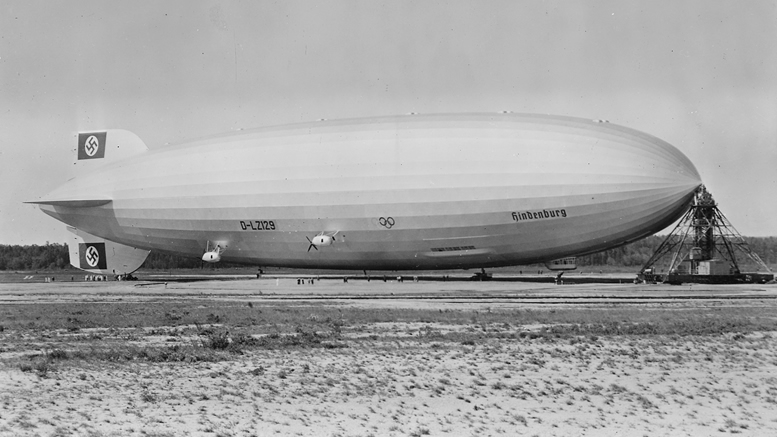
In the 1930s, Zeppelins were used for luxury passenger transport. However, in 1937 one of Germany’s Zeppelins, the Hindenburg, burst into flames, and effectively ended its widespread use. Many debates have raged as of the cause of the disaster. Most people believed that it was the hydrogen that caused the fire seen on the famous footage of the explosion but others have argued that hydrogen burns with a clear flame, so it was the material of the shell of the airship that caused the fire. Modern airships are filled with the much safer helium gas.
Following the war the aeroplane took the place of airships for passenger transport as they were faster and more reliable. Plenty of ex air force pilots also jumped at the chance to get back into a plane, some of which were left over wartime craft pushed into passenger service. Soon the airship would only used for advertising, photographic and scientific work. The most famous of these is the Goodyear blimp. Blimps differ from Zeppelins as blimps do not contain any frame so the massive balloon structure you see is just a big balloon of gas. Goodyear replaced their blimps with a semi rigid airship manufactured by the Zeppelin company in 2014.