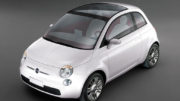
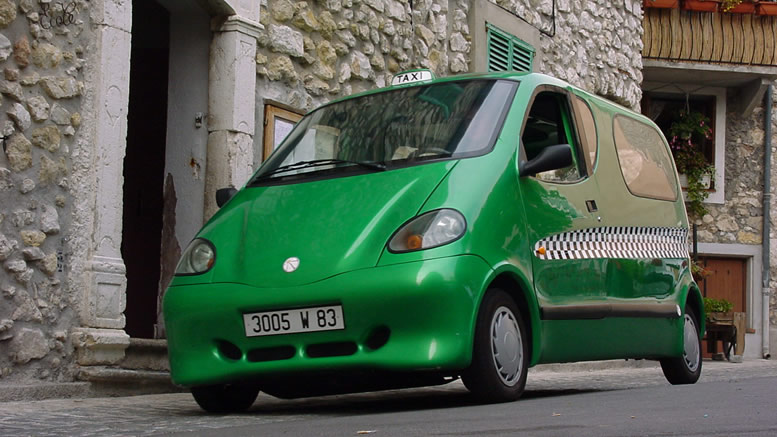
 As the push to find cleaner alternatives to Fossil Fuels accelerates one new car company is planning to make a car that runs on thin air. using compressed air the MDI Air Car is capable of a top speed of 110 km/h and can travel 300 kilometres on one tank of fuel and at a cost of just a penny per kilometre. All of this at “zero pollution”. In fact the car cleans the air it uses!
The secret is in the state of the art engine, instead of relying on petrol to create the explosion that in turn makes the engine turn, the air car uses an air engine which takes the compressed air from its tanks and used this to make the engine turn, this leaves you with an exhaust of plain air.
The MDI vehicles will be equipped with a range of modern systems. For example, one mechanism stops the engine when the car is stationary (at traffic lights, junctions etc). Another interesting feature is the pneumatic system which recovers about 13% of the power used.
The MDI car body is built with fibre and injected foam, as are most of the cars on the market today. This technology has two main advantages: cost and weight. Nowadays the use of sheet steel for car bodies is only because of cost – it is cheaper to serially produce sheet steel bodies than fibre ones. However, fibre is safer (it doesn´t cut like steel), is easier to repair (it is glued), doesn´t rust etc. MDI is currently looking into using hemp fibre to replace fibre-glass, and natural varnishes, to produce 100% non-contaminating bodywork.
The MDI engine works with both air taken from the atmosphere and air pre-compressed in tanks. Air is compressed by the on-board compressor or at service stations equipped with a high-pressure compressor.
Before compression, the air must be filtered to get rid of any impurities that could damage the engine. Carbon filters are used to eliminate dirt, dust, humidity and other particles which, unfortunately, are found in the air in our cities.
This represents a true revolution in automobiles – it is the first time that a car has produced minus pollution, i.e. it elimates and reduces existing pollution rather than emitting dirt and harmful gases. The exhaust pipe on the MDI cars produces clean air, which is cold on exit (between -15º and 0º) and is harmless to human life. With this system the air that comes out of the car is cleaner than the air that went in.
Based on its experience in aeronautics, MDI has put together highly-resistant, yet light, chasses, aluminium rods glued together. Using rods enables us to build a more shock-resistant chassis than regular chasses. Additionally, the rods are glued in the same way as aircraft, allowing quick assembly and a more secure join than with welding. This system helps to reduce manufacture time.
Guy Nègre, inventor of the MDI Air Car, acquired the patent for an interesting invention for installing electrics in a vehicle. Using a radio transmission system, each electrical component receives signals with a microcontroller. Thus only one cable is needed for the whole car. So, instead of wiring each component (headlights, dashboard lights, lights inside the car, etc), one cable connects all electrical parts in the car. The most obvious advantages are the ease of installation and repair and the removal of the approximately 22 kg of wires no longer necessary. Whats more, the entire system becomes an anti-theft alarm as soon as the key is removed from the car.